Showing posts with label book:memoir. Show all posts

Friday, April 22, 2016

Book Synchronicity

There are moments when the book you're reading just resonates with something else in my life. I am reading a historical fiction and the next day, read an article about the very same topic. Or I am reading a novel which heavily involves spinning yarn, soon after I learned to spin myself.

But it is very odd when two books I'm reading complement each other. It just happened to me and it was magical. I had just finished listening to Janis Ian's autobiography Society's Child. Ian, for those who may not know, was a pretty famous folk and pop singer in the 60's and 70's, and rubbed elbows people like Janis Joplin and Bruce Springsteen. She was heavily involved in the folk music movement with the likes of Pete Seeger and Arlo Guthrie. She talked a lot about the other performers she sang with, toured with, and befriended. I really enjoyed hearing her tell her story, peppered with bits of her songs, some of which I knew, and others which I hadn't.

In her autobiography, Ian is pretty frank about how the music industry has changed through the decades since she started recording, and in her opinion, not for the better. She implies heavily that the industry has lost its heart and instead of fostering and nurturing its artists, it is too focused on money and protecting the bottom line. As she had to make a comeback several times in her career and had been performing since she was a teenager, she has many thoughts on this subject.

While I was finishing up Society's Child, I picked up a review copy of a young adult novel that is coming out in May called Devil and the Bluebird. It is the debut novel of Jennifer Mason-Black, and if this first book is any indication, she will have a place on my insta-buy list. It is just that good and my first solid five-star read of 2016.

In Devil and the Bluebird, we start off at the crossroads at midnight and watch Blue Ridley make a deal with the devil: her voice in exchange for magic boots that will lead her to her missing older sister, who had run away from home shortly after their mother had died. Armed only with her guitar, she follows the path the boots lead her. The story is reminiscent of Neil Gaiman's American Gods and Seanan McGuire's Sparrow Hill Road, but is still completely unique. Unlike a lot of young adult books these days, Devil and the Bluebird is not focused on the here or the future. There are no name droppings of current movie stars or pop artists. There aren't worries about designer clothes or the latest iProduct. Instead, this book is nostalgia personified, and takes place in a part of America that still remembers people busking by the side of the road, exchanging a meal for a story or a song, and finding a shared language in music.

Reading this on the coattails of Society's Child was pure book synchronicity. It was kismet. The folk revolution that Janis Ian described and took part in was still going on in the roads Blue traveled in Devil and the Bluebird. The ghosts of folk music past are in these pages, and Blue learns the difference between making music for fame and fortune (the real deal with the devil) and making music from the heart and the soul.

I cannot recommend both books enough. And if you read them back-to-back, you may find your own moment of book synchronicity.

Society's Child by Janis Ian is available in audiobook from Audible, and in print at all major retailers.
Devil and the Bluebird by Jennifer Mason-Black is out May 17th from Amulet Books.

Monday, October 5, 2015

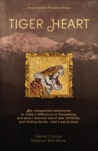
Review: Tiger Heart

Tiger Heart: My Unexpected Adventures to Make a Difference in Darjeeling, and What I Learned about Fate, Fortitude, and Finding Family Half a World AwayTiger Heart: My Unexpected Adventures to Make a Difference in Darjeeling, and What I Learned about Fate, Fortitude, and Finding Family Half a World Away by Katrell Christie
My rating: 4 of 5 stars

Disclaimer: I received a free advanced review copy from the publisher via Netgalley.
"Today, our teacher told us about the number zero, which has no worth," she said.
"But put it next to another number, and it makes that number important. The more zeros you add, the bigger the number gets. So know that if you are feeling like a zero, you do have great worth with teamwork."

That quote basically sums up the entire message of the book for me. Katrell Christie's mission of bettering the lives of these girls in Darjeeling, India would be impossible without help.

I've heard of The Learning Tea before. I'm a bit of a tea obsessive, with cupboard overflowing with the dried leaf. I remember finding the website at some point, looking at the tea and considering buying some. I ended up not, only because I am not a fan of darjeeling tea, finding it lacking the depth and subtlety of flavor that I find in teas from China, Japan, and Taiwan. But The Learning Tea stayed somewhere in the back of my mind and when I saw this book on Netgalley, I immediately requested it.

Tiger Heart is part memoir, part call to action, part marketing material, and part feel-good "find the good in the world" missive. It's deceptively simple, with clear writing and short chapters interspersed with motivational quotes from well-known thinkers or writers. On the surface, the book is simply Christie's journey that led her to create The Learning Tea, and where The Learning Tea is today. But it's more. It's also the story of one person making a difference -- but not on her own.

I think that's the most powerful message in this book. Unlike another international development NGO founder who was outed to be a fraud after writing several best-selling books, Christie never portrays herself as the hero, single-handedly moving mountains. She's honest in what she doesn't know, what she had to learn. She's humble in her quest, focusing on helping the individuals she can. And she's upfront with her failures.

She could have very easily sensationalized her story, and it was a bit of a shock when I came across this:
I’ve made it through two armed robberies, one attempted carjacking at gunpoint, one knife holdup, and one hijacked train. I was smuggled through a political war zone in the hatchback of a car covered in burlap. I’ve tossed on a burka to be able to ride the train by myself. Throw in a handful of death threats. And then there’s bullying from people who don’t want my low-caste scholars to take seats away from their rich kids at school.

Because Christie, while making it clear throughout the book that it was incredibly difficult and draining to do what she does, never up until that point toward the end of the book, mentioned it was also dangerous.

But the story wasn't about her and her being the hero. It's about the girls who are being helped, and India.

View all my reviews

Thursday, September 17, 2015

Review: The Only Woman in the Room by Eileen Pollack

The Only Woman in the Room: Why Science Is Still a Boys' ClubThe Only Woman in the Room: Why Science Is Still a Boys' Club by Eileen Pollack
My rating: 4 of 5 stars

Disclaimer: I received a free advanced review copy from the publisher via Netgalley.

The description for this book is a bit misleading. The first half is Pollack's memoir of her own experiences as a student from childhood in public school in a predominantly Jewish area through college at Yale as one of the few female physics majors. The second half of the book is more in line with what I had been expecting given the description, and includes anecdata from other women who Pollack had known or interviewed from her own generation and the later generation of female science majors and scientists, as well as recaps of interviews with her former professors and teachers who we had met in the first half of the book.

This is a deeply personal story for Pollack, but at the same time it is also deeply personal for every girl who thought she wasn't smart enough, or every woman who decided to drop out of a science major, or every student who didn't even try for a science degree in the first place. This book was deeply personal for me.

Pollack's experiences are not every woman's or minorities' experiences, but they are similar enough that many can relate. One of my criticisms of this book is Pollack's weakness in connecting women's experiences with the similar experiences of minorities and economically disadvantaged students. She does mention that several times, but it is definitely a message that can be strengthened. Towards the end of the book, Pollack noted that some students, even if they enter into college at the top of their high school graduating class, find themselves floundering and behind other students because they were not privileged enough for their schools to offer certain courses. I wish Pollack had highlighted that more because it's a problem that systemically places students from under-served, poorer schools at a disadvantage in college.

I write this review the day after a 14-year-old Muslim boy with brown skin was detained by his school and arrested for bringing in a homemade clock to show off to his science teacher, which another teacher reported as a bomb. That is an extreme case of the educational culture discouraging a minority from entering a STEM field, but it highlights the challenges that some students face by virtue of their sex or ethnicity.

Pollack's story is an important one, and both its strength and weakness is its reliance on anecdotes (what I referred to as "anecdata" earlier) from her own experiences and gleaned from interviews or missives with other women or minorities. She does mention the results of a few studies of bias against women in STEM, but the bulk of the book are anecdata rather than empirical controlled studies. The anecdata bring the problems to life in a way that pure numbers don't, yet at the same time anecdotes are easy for those in the sciences to discount because they are not data (hence why I have been referring to them as "anecdata" because, well, it can be argued that the plural for anecdote is data).

Given the larger conversation that has been on-going for the past few years of women in the sciences, and the blatant misogyny that I keep running up against from big names (Google "Richard Dawkins women"), The Only Woman in the Room is an important book, and very timely. Remember in June when Nobel Laureate in Physiology or Medicine Tim Hunt said at a science conference in South Korea, “Let me tell you about my trouble with girls. Three things happen when they are in the lab: You fall in love with them, they fall in love with you, and when you criticize them they cry”? Or last November when European Space Agency Rosetta Project scientist Matt Taylor gave public interviews after the Philae space probe landed on a comet while wearing a shirt covered in nearly naked women? It is heartening, I guess, that all of these incidents have lead to huge public outcries and public apologies (in the case of Taylor) or firings (in the case of Hunt). A decade or two earlier, they would have been the status quo.

I hope that Pollack's book inspires change in STEM education at all levels, and I hope that it also inspires women to pursue STEM educations and careers.

View all my reviews

Thursday, February 3, 2011

Book Review: Do Tampons Take Your Virginity?

Title: Do Tampons Take Your Virginity? A Catholic Girl's Memoir
Author: Marie Simas
Publisher: Self-published via CreateSpace
Publication Date: September 2010
Pages: 161

Note: Free review copy received from the author via Goodreads Giveaways program.

The quality of self-published books varies across the board from truly horrendous to truly spectacular. Simas' book falls somewhere in the middle but definitely leans towards the spectacular end of the spectrum.

Ignore the title - I know, you want to react to it. Just ignore it. As horrible as it is, it did its job as it made me give the book a second look. However, it is incredibly misleading. This is the memoir of a girl, who just happens to be Catholic, growing up in a household with a controlling and abusive father. Very little is mentioned about religion; instead, Simas focuses on the abuse she was forced to endure and witness while growing up, and how her experiences shaped and affected her adulthood. Much of the oppressiveness of her household which she probably ascribes to religion is more accurately cultural norms and expectations.

Simas' parents were immigrants from Portugal. Her father was a teacher in the school district. Her mother was a homemaker who suffered from brain cancer. Simas candidly talks about how her father would beat her if she got in trouble at school or got bad marks, would come home to rape her mother, and ruled the household through intimidation and tight control of power. The short, episodic nature of the narrative mirrors Simas' own memories of her childhood and life. While she focuses on negative experiences, she does so unflinchingly and defiantly with a touch of tongue-in-cheek humor. Even her own bad behavior is honestly portrayed, particular the period in her life where she tries and asserts her own power over the guys she dates.

I gathered that writing this book was a cathartic experience for Simas, and that the process helped her move past the abuse. I imagine so, anyway, as the last few pages were much more hopeful and positive than the rest of the book. I truly admire Simas. I don't know if I could have survived in her family situation and emerged even half-way functioning.

I loved my mother, but I couldn't forgive her weakness.

Wednesday, January 19, 2011

Book Review: 84, Charing Cross Road

A few weeks ago, I was frantically trying to watch a few of the movies on my Netflix Instant queue before they expired on the first of the month. One that I watched was 84 Charing Cross Road, a 1987 film starring Anne Bancroft as Helene Hanff, a wise-cracking New York writer with a love affair with classic English literature. Fed up with the lack of such books in America, she writes to Marks & Co, a London antiques bookshop, starting a decades-long friendship with book dealer Frank Doel (masterfully portrayed by Anthony Hopkins). I was charmed, mesmerized, and instantly smitten with the movie. It reminded me very much of Love Letters, a play by A.R. Gurney which consists entirely of two people sitting on stage reading letters back and forth.

After I finished the movie, I immediately searched online to see if it was based on a book (what does that say about Hollywood that a movie I found smart, funny, and witty had to be based on a book?) and it was! A book of letters! Actual letters, in fact, and not fictional, made-up ones. Of course, I immediately bought it, because I was sure I was going to love it. I was so sure, in fact, that I didn't just buy 84, Charing Cross Road, but the Helene Hanff Omnibus which collects all five of Hanff's memoir-esque books into one fat, delicious volume.

The book fortuitously arrived just as I was finishing The Evolution of Calpurnia Tate so I was able to immediately dive right in. I skipped over Underfoot in Show Business, the author's memoir of trying to make it as a playwright in 1940's New York, and started in on 84.

I loved it.

The book is short. The first edition only clocked in at 95 pages, but boy howdy, what a 95 pages. Obviously, not every letter is included and often months or even a year or more passes between letters. But despite those omissions, the letters between Hanff and Doel (interspersed with letters to/from others at Marks & Co. and Doel's wife Nora) are everything I expected. Hanff's writing is rich, alive, spontaneous, and open - I could almost hear her shouting in my head. Doel's words are more reserved, filled with British reserve but no less warm.

84, Charing Cross Road is Hanff's loving tribute and memorial to her remarkable two-decade friendship to a man an ocean away, a man who she never met, over a shared love of books.

I do wish that there were more letters - just so that I could have visited longer with Helene, and Frank, and the others. Thankfully, as soon as I finished 84, Charing Cross Road, I was able to immediately start on The Duchess of Bloomsbury Street, Hanff's diary of her trip to London after the publication of 84.

"I love inscriptions on flyleaves and notes in margins, I like the comradely sense of turning pages someone else turned, and reading passages someone long gone has called my attention to."

Sunday, September 7, 2008

Book Review: Three Cups of Tea

Three Cups of Tea: One Man's Mission to Promote Peace . . . One School at a Time by Greg Mortenson and David Oliver Relin

Book Description: In 1993 a mountaineer named Greg Mortenson drifted into an impoverished Pakistan village in the Karakoram mountains after a failed attempt to climb K2. Moved by the inhabitants' kindness, he promised to return and build a school. Three Cups of Tea is the story of that promise and its extraordinary outcome. Over the next decade Mortenson built not one but fifty-five schools--especially for girls--in the forbidding terrain that gave birth to the Taliban. His story is at once a riveting adventure and a testament to the power of the humanitarian spirit. (from back cover)

I picked this book up on a whim before it made international best sellers lists and won the Kiriyama Prize, among other awards. It sat collecting dust for a little bit as I read another I had bought at the same time. I then sat down with Three Cups of Tea and I was blown away. The story of Mortenson's struggle, determination, and eventual successes held me captive and gave me hope that the world can be a better place for our children, and our children's children. After reading, I donated money to Mortenson's non-profit, The Central Asia Institute. CAI is my charity of choice now.

Mortenson's story proves that one man can make a difference in the world. He has dedicated his life to building schools in one of the most violent and dangerous regions of the world because he believes that education can truly improve the lives of people. This is something I believe myself, and I greatly admire Mortenson and others like him for promoting peace, alleviating poverty, and providing the chance for a better life through education.

This is a book that I believe everyone should read. In the world we live in full of prejudice, violence, and hate, a story of one man who set out to change the world for the better -- and did -- is a story that should be told often and shared as much as possible.